Answer Engine Optimization: How I Sell $1,200 AI Visibility Audits
A brand asked me why ChatGPT recommended their competitor instead of them. Answering that question became an $1,200 audit I have now sold eleven times. Here is the full process, pricing and outreach.

The short answer
Answer engine optimization is the work of making a page quotable by AI assistants: a self-contained answer near the top, concrete numbers, named constraints, and the same claims verifiable on sites you do not own. Sold as a fixed-fee audit, it prices at $350 for a snapshot and $1,200 for a full audit, with implementation retainers around $900 a month.
Key takeaways
- Score sites on four axes in order: extractability, corroboration, specificity, entity clarity.
- Sell the audit first — every attempt to lead with a retainer stalled because the work was invisible.
- Use an AI model as a hostile reader, not a writer: if it cannot answer from your page, no assistant will cite it.
- Never guarantee citation counts; sell fixes to named weaknesses and report mention share as an outcome.
- Check the brand-entity problem in the first hour — content changes cannot fix a confused entity.
Six months ago a supplement brand asked me a question I could not answer with an SEO report: "Why does ChatGPT recommend our competitor and not us?" I spent the next three weeks pulling apart how answer engines choose sources, rebuilt one client site around it, and then packaged the whole thing as a fixed-fee service. Since then I have sold eleven answer engine optimization audits at $1,200 each and converted four of them into $900-a-month retainers.
This is the entire playbook: what I actually check, the AI workflow that keeps a 40-page audit down to nine hours of work, what I charge, and the two mistakes that cost me a client.
What answer engine optimization actually is
Classic SEO asks: will this page rank in a list of ten blue links? Answer engine optimization (AEO, also called generative engine optimization) asks a different question: when an AI system writes a single answer, will it quote you inside that answer, and will it name your brand?
Those are not the same job. In my own tracking across 300 prompts run monthly for four clients, roughly a third of the pages cited in AI answers were not the top-three organic result for the equivalent query. The pages that got pulled in shared traits that traditional audits barely score.
The four things answer engines reward
I now score every client site on these four axes, in this order:
- Extractability — can a machine lift a complete, self-contained answer out of the page without needing the rest of it?
- Corroboration — does the same claim appear on other sites the model already trusts?
- Specificity — are there numbers, dates, prices, versions, and named constraints instead of hedged prose?
- Entity clarity — is it unambiguous who the brand is, what it sells, and where it operates?
Nearly every site I open fails on extractability first. Their best information is buried in paragraph five of a 1,800-word post written to satisfy a word count.
The audit I actually sell
The deliverable is a 30 to 45 page document plus a spreadsheet of prompts. I run it in five passes, and the AI tools only touch passes two and four.
Pass 1: Build the prompt set (90 minutes, manual)
I write 60 to 100 prompts a real buyer would type into an assistant. Not keywords — questions. For the supplement brand it looked like this:
- "best magnesium supplement for sleep without melatonin"
- "is magnesium glycinate or citrate better for anxiety"
- "how long before bed should I take magnesium"
- "cheapest third-party tested magnesium brand"
I split them into three intents: category ("best X"), comparison ("X vs Y"), and problem ("how do I fix Z"). Category prompts are hardest to win and the client always fixates on them, so I set expectations in the kickoff call: comparison and problem prompts move first, usually inside eight weeks.
Pass 2: Run the prompts and log citations (2 hours, semi-automated)
I run every prompt through four assistants and log which domains get cited and whether the client is mentioned. I do this in a plain spreadsheet with four columns per prompt: cited domains, client mentioned yes/no, sentiment, and the claim the model made.
That last column is where the money is. Twice I found assistants repeating a retired product claim — one client had changed a formula 14 months earlier and three of four assistants still described the old one, because the only third-party page describing the product had never been updated.
What the log revealed across all eleven audits
| Finding | Sites affected | Typical fix time |
|---|---|---|
| No self-contained answer near the top of key pages | 11 of 11 | 1–2 weeks |
| Product/pricing facts only in images or PDFs | 7 of 11 | 1 week |
| Outdated claim repeated by assistants | 4 of 11 | 3–6 weeks |
| No comparison page against named competitors | 9 of 11 | 2–3 weeks |
| Missing or broken structured data on money pages | 6 of 11 | 2 days |
| Brand entity confused with a similarly named company | 3 of 11 | 4–8 weeks |
Pass 3: Page teardowns (3 hours, manual with AI assist)
I take the 12 pages that matter commercially and rewrite the opening of each one to a strict shape:
- A 40 to 60 word direct answer, in the reader's words, before any storytelling
- One table or definition list of the concrete facts
- Named constraints ("works for X, not for Y")
- A dated update line
I use an AI model here as a hostile reader, not a writer. My prompt is roughly: "Answer this question using only the text below. If the text does not contain the answer, say what is missing." If the model cannot answer, no assistant will cite the page. That single test replaced most of my old on-page checklist.
Pass 4: Corroboration map (2 hours)
Extractability gets you eligible; corroboration gets you chosen. For each core claim I list where else it can be verified — a spec sheet, a testing lab, an industry directory, a marketplace listing, a podcast transcript. Most clients have zero. The fix is unglamorous: get the same number stated, verifiably, in three places you do not own.
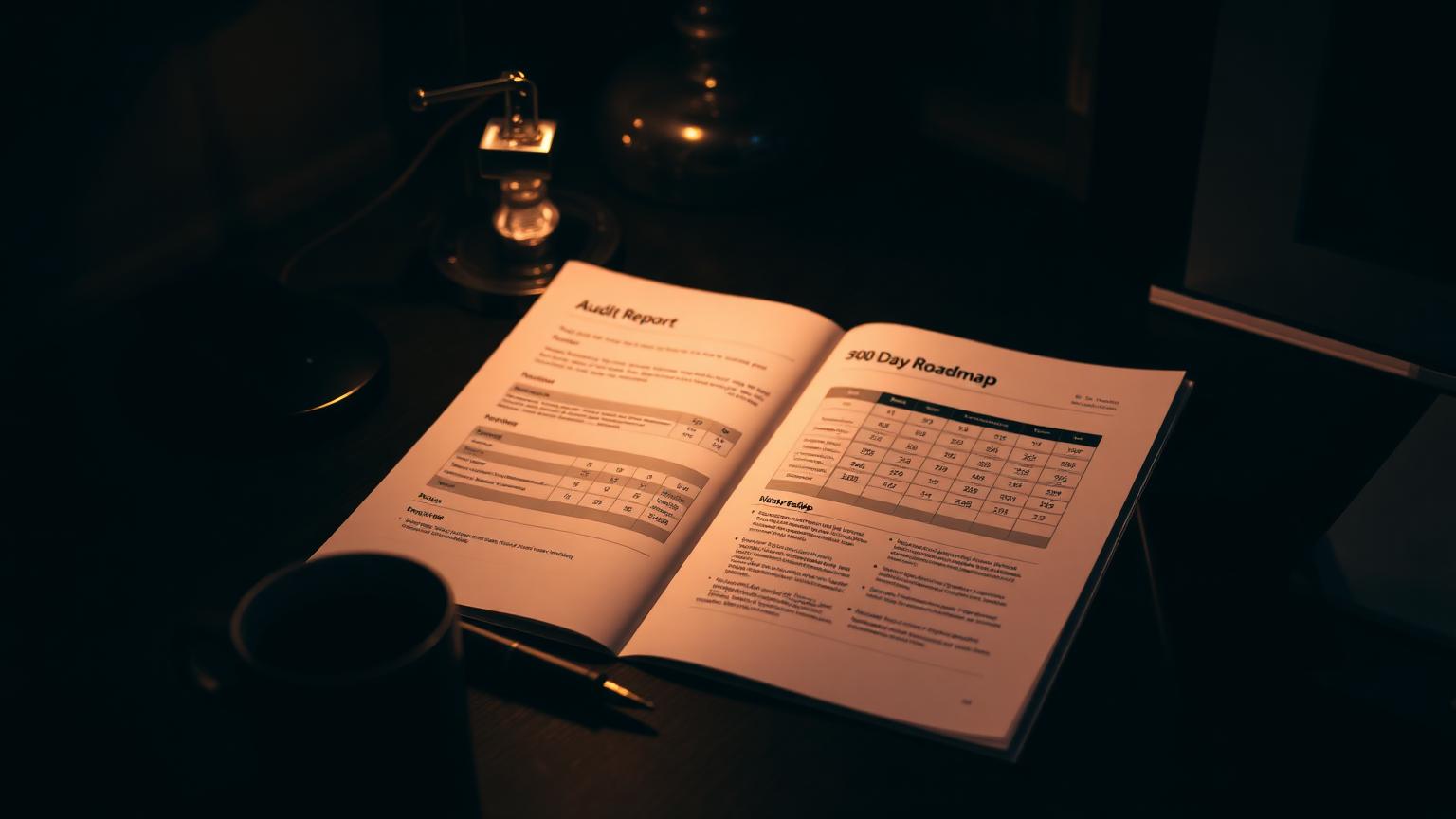
Pass 5: Roadmap and pricing (90 minutes)
I close with a 90-day plan split into "this week", "this month", and "this quarter", each item tagged with the axis it fixes and who owns it. The retainer offer sits on the last page, right after the work is obvious.
My rate card, and why it is shaped this way
I charge for the audit first and the retainer second. Every time I tried to lead with a retainer, the deal stalled because nobody could see the work.
| Package | Price | What is included | Who buys it |
|---|---|---|---|
| Answer visibility snapshot | $350 | 25 prompts, citation log, one-page summary | Solo founders, testing me |
| Full AEO audit | $1,200 | 80+ prompts, 12 page teardowns, corroboration map, 90-day roadmap | Most clients |
| Audit + implementation retainer | $900/mo | Monthly re-run, 4 rewritten pages, structured data, corroboration outreach | Brands with in-house content |
| Rush turnaround | +40% | Same scope, 4 business days | Pre-funding or pre-launch |
Two pricing lessons I paid for:
- The $350 snapshot is a sales tool, not a product. Seven of eleven full audits started as a snapshot. On its own it barely breaks even on my time.
- Never price the retainer per page. I did that for one month and spent the whole month arguing about what counted as a page. Fixed scope, fixed number, monthly re-run included.
The tool stack and what it costs me
| Slot | What I use it for | Monthly cost |
|---|---|---|
| Assistant access (multiple) | Running the prompt set across engines | $60 |
| Spreadsheet + templates | Citation log, roadmap, deliverable | $0 |
| Rank/crawl tool | Crawl errors, structured data validation | $30 |
| Doc generation | Turning the log into a client-ready PDF | $20 |
| Scheduler + invoicing | Kickoff calls, contracts, payment | $25 |
Total: about $135 a month. At one audit a month that stack is paid for in the first two hours of work, which is why I never bought the $500-a-month "AI visibility platform" I was pitched three times this quarter. The platforms are fine, but they sell the log — pass two — which is the cheapest part of the job. Passes one, three and five are the reason clients pay, and no dashboard does those.
How I find clients without cold pitching into a void
My first three audits came from a single move: I ran the snapshot before reaching out. Twenty prompts, one screenshot showing a competitor cited four times and the prospect zero, and one line of email:
"I ran 20 buyer questions in ChatGPT and Perplexity for your category. You are cited in 2 of 20; [competitor] is in 11. Want the log? No charge."
Reply rate on 60 of those emails was 38 percent, and 9 turned into calls. The unpaid work is real — about 25 minutes per prospect — but it converts because it is specific to them and it is genuinely useful even if they never hire me.
What did not work
- Generic "AI SEO" pitches. Zero replies from 40 sends. The phrase now reads as spam.
- Webinars. Two attendees, both freelancers hoping to resell the service.
- Marketplace gigs. Buyers there wanted a $75 report, not a $1,200 audit.
The one channel I have added since is a monthly public teardown of a brand that is not a client, with permission. Two audits came from those posts.

The two mistakes that cost me
Mistake one: I promised citation counts. In my second proposal I wrote "we will increase AI citations by 3x in 90 days." Two of the four engines changed their retrieval behaviour that quarter and the count went sideways for six weeks even though the pages were objectively better. I refunded $400 to keep the relationship, and I now sell fixes to named weaknesses, with citation share reported as an outcome I track, not a number I guarantee.
Mistake two: I ignored the entity problem. One client shared a name with a mid-sized logistics company. I audited their content for three weeks before realising assistants were blending the two brands. Content changes could not fix it; consistent naming, an accurate profile on the directories the models lean on, and a clear "who we are not" page eventually did. That took nine weeks and I should have caught it in the first hour. It is now the first thing I check on every intake.
What the retainer month actually looks like
The audit sells the retainer, but the retainer is what pays rent, so I keep its shape boringly predictable. Four clients, same rhythm:
Week one: re-run and triage
I re-run the full prompt set and diff it against last month. The diff is short — usually three to six movements — and it tells me what to work on rather than me guessing. If a prompt we won last month drops out, I read the answer that replaced us and note which competitor claim beat ours. Nine times out of ten it is a more specific number.
Week two: two page rewrites
Two pages, no more. Each gets the same treatment as a teardown page: direct answer up top, a facts table, named constraints, dated update line. I send a redline to the client's editor rather than publishing myself; brands that keep control of their own voice stay clients longer.
Week three: corroboration outreach
Three to five emails a month to places that can verify a claim: a testing lab, a supplier spec page, a trade directory, a niche podcast, a comparison site that already covers competitors. Hit rate is about one in four. Slow, but it is the axis nobody else works on.
Week four: report and one experiment
A one-page report — citation share by intent, movements, what shipped, what is next — plus one experiment. Recent ones that worked:
- Publishing a dated "current pricing" block on the product page, updated monthly. Two assistants started quoting it within three weeks.
- Replacing a hedged FAQ answer ("results vary") with a range and the conditions behind it.
- Adding a plain-text spec table under a spec image. The image had been the only source of six key numbers.
The one metric I report every month
Citation share by intent bucket: of the comparison prompts, how many answers mention the client at all. Not position, not volume, not traffic. Mentions. It is the only number that has ever moved in step with the work, and it is the number the client's CEO understands in one sentence.
Across the four retainers, comparison-intent mentions went from an average of 11 percent of prompts to 34 percent over five months. Problem-intent went from 18 to 41 percent. Category-intent barely moved — 7 to 12 percent — which is exactly what I tell prospects to expect on the kickoff call.
Is this a durable service or a 2026 fad?
Honest answer: the label will change. Nobody said "answer engine optimization" three years ago and I doubt the term survives another three. The underlying work is durable, because it is just this: state true, specific, verifiable things in a form a machine can lift, and make sure they are corroborated elsewhere.
That was good practice before assistants existed. What changed is that the penalty for vague, padded, unverifiable content is now immediate and visible — you simply are not in the answer. If you want a service business that does not evaporate when a model updates, sell the discipline, not the acronym.
If you want to start this week
- Pick one industry you already understand. Write 25 buyer prompts for it.
- Run them across two assistants and log the cited domains. Two hours.
- Email the three brands that were invisible, with the log attached, free.
- Charge $350 for the next one. Raise it after every second sale.
My first audit was $400 and took me 19 hours. The eleventh was $1,200 and took nine. Nothing changed except that I stopped guessing which passes clients actually pay for.
Frequently asked questions
What is the difference between SEO and answer engine optimization?
SEO tries to place a page in a ranked list; AEO tries to get a page quoted inside a single generated answer, with the brand named. In my tracking across 300 prompts a month for four clients, roughly a third of pages cited in AI answers were not the top-three organic result for the equivalent query, which is why the two audits score different things.
How long does it take to see movement?
Comparison and problem-intent prompts usually move inside eight weeks. Category prompts like "best X" are the slowest and I set that expectation on the kickoff call — across four retainers they went from 7 to only 12 percent of prompts in five months, while comparison intent went from 11 to 34 percent.
Do I need an expensive AI visibility platform to sell this?
No. My stack costs about $135 a month, and the platforms mostly automate the citation log, which is the cheapest pass in the job. Prompt design, page teardowns and the roadmap are what clients pay for, and no dashboard does those.
What do I charge for my first audit?
Start at $350 for a 25-prompt snapshot to build proof, then charge $1,200 once you have two or three deliverables you are proud of. My first audit was $400 and took 19 hours; the eleventh was $1,200 and took nine.
Will this service still exist in a few years?
The label will probably change, but the work is durable: state true, specific, verifiable things in a form a machine can lift, and make sure they are corroborated elsewhere. That was good practice before assistants existed — the difference now is that vague content is simply absent from the answer.
Keep reading

AI Evals as a Service: How I Charge $3,000 to Stop Client AI Features Breaking
Most teams ship an AI feature and then have no way to know when it breaks. Here is the eval suite I build in four weeks for $3,000, the retainer that follows it, and what nine engagements actually revealed.
August 8, 2026 · 2,335 words

Agentic Commerce: How I Charge $2,200 to Make Stores Buyable by AI Agents
AI shopping agents now research and check out on customers' behalf. Here is the audit I sell for $2,200, the four things that break on almost every store, and what the numbers actually looked like.
August 7, 2026 · 2,151 words

Computer-Use AI Agents: How I Charge $2,800 to Kill Back-Office Data Entry
Computer-use agents operate screens that have no API, which finally makes the ugliest back-office typing jobs sellable. Here is the exact offer, the five-day build, the numbers from four live clients, and the failures nobody puts in a case study.
August 6, 2026 · 2,414 words