AI Voice Agents for Local Businesses: How I Built a $5,000/Month Retainer Service
This playbook shows how I built a $5,000/month retainer business selling AI voice agents to local service businesses. You will see the exact stack, pricing tiers, outreach scripts, and the mistakes that almost killed the model.
The short answer
You can make money with AI voice agents by building appointment-booking and missed-call follow-up systems for local service businesses such as salons, clinics, and home-service contractors. Charge a $500-$1,500 setup fee plus $300-$800 per month per agent for ongoing monitoring and improvements.
Key takeaways
- AI voice agents solve real revenue leaks: missed calls, after-hours leads, and slow follow-up.
- The best first clients are service businesses that book appointments by phone and already spend money on ads.
- A working demo is more persuasive than any pitch deck; record a 60-second call with a real-sounding agent.
- Pricing should combine a setup fee with a monthly retainer so you are paid for both build and maintenance.
- Compliance, disclosure, and human handoff are non-negotiable for trust and long-term retention.
AI Voice Agents for Local Businesses: How I Built a $5,000/Month Retainer Service
Six months ago I had never sold a phone call in my life. Today I run a small AI automation service that books appointments, qualifies leads, and follows up missed calls for local businesses. The monthly retainer revenue just crossed $5,000. More importantly, the clients are sticky. Once a business sees its calendar fill up while the owner is sleeping, dinner, or on another job, canceling feels like turning off a faucet.
This article is not theory. It is the exact model I used, the tools I paid for, the outreach scripts that worked, the pricing that converted, and the mistakes that cost me two early clients. If you want to make money with AI in 2026, AI voice agents are one of the most direct paths I know.
What Are AI Voice Agents and Why Local Businesses Pay Premium
An AI voice agent is a software system that answers incoming phone calls, understands the caller, and completes a useful task. That task might be booking an appointment, collecting contact details, answering FAQs, or transferring a hot lead to a human. The voice sounds natural because modern agents combine large language models with high-quality text-to-speech. The caller often does not realize they are speaking to software until the agent tells them.
Local businesses pay premium for this because phone calls are leaking money everywhere. A salon misses a call during a blow-dry. A dental clinic sends a patient to voicemail at lunch. An HVAC contractor is on a roof and cannot answer. Every missed call is a potential booking that goes to a competitor. A slow follow-up drops the chance of conversion by half within an hour.
I did not invent this pain. I validated it by calling twenty small businesses and asking one question: "How many calls do you miss in a typical week?" The average answer was eleven. When I asked what happened to those callers, the answers were grim: voicemail, nothing, or a callback the next day. That gap is the business.
The Three Services That Actually Sell
I tested several offers. Three converted consistently. Everything else was a distraction.
1. Appointment Booking Agent
The agent answers the business line, checks availability in real time, and books the caller directly into Google Calendar, Calendly, or the practice management system. This is the easiest sell because the ROI is obvious: every booked slot is revenue.
2. Missed-Call Follow-Up
When the business misses a call, the agent calls the lead back within two minutes. It apologizes for the missed connection, asks what they need, and books or qualifies them. Speed is the product here.
3. Lead Qualification Before Transfer
For businesses that run paid ads, the agent screens callers before passing them to a salesperson. It asks budget, timeline, and service type, then transfers only qualified prospects. This saves the owner hours of unqualified calls.
My Exact Stack and Monthly Costs
I keep the stack simple. Complexity kills margins when you are starting.
| Layer | Tool | Monthly Cost per Client | Purpose |
|---|---|---|---|
| Voice platform | Bland AI | $80-$120 | Handles calls, voices, transcripts |
| Workflow automation | n8n self-hosted | $20 | Connects calendar, CRM, notifications |
| Calendar | Google Calendar | Free | Real-time availability |
| CRM / database | Airtable | $20 | Stores leads and call logs |
| Phone number | Twilio | $15 | Local business number |
| Monitoring | Custom dashboard | Free | Call volume, bookings, errors |
| Total | $135-$175 |
I charge a $900 setup fee and $600 per month for a single-agent package. My cost is roughly $150 per month, so the gross margin is healthy. For clients with two numbers or advanced integrations, I charge $1,200 per month.
The voice platform is the most important choice. I started with a cheaper provider and the latency was painful. Callers noticed the awkward pauses. I switched to Bland AI and the close rate on demos improved immediately. Do not optimize for price here. Optimize for natural conversation.
How I Landed My First Three Clients
My first client was a med spa that spent $4,000 per month on Google Ads but had no one answering the phone reliably. I found them by searching local service ads, calling during business hours, and getting sent to voicemail. That was my signal.
The Outreach Script That Worked
I did not send cold emails. I walked in or called during slow hours. My script was short:
"Hi, this is [name]. I help [salons/clinics/contractors] book more appointments without hiring another receptionist. I noticed your phone went to voicemail earlier today. Would you be open to a free demo where I show you an AI agent booking a test appointment for your business? It takes five minutes."
The key phrase is "free demo." Prospects do not understand voice agents until they hear one. A five-minute demo is lower risk than a sales call.
The Demo That Closed
I built a generic demo agent for each niche. During the meeting I handed the owner my phone, had them dial a number, and pretended to be a new customer. The agent answered, asked what service they wanted, checked a demo calendar, and booked a fake slot. The owner's reaction was always the same: surprise, then questions about price.
I closed my first three clients within ten days using this method. Two came from in-person demos. One came from a Facebook group where local business owners complained about missed calls.

Pricing That Converts
Pricing is where most beginners fail. They either charge too little and drown in support, or too much and never close. I use three tiers.
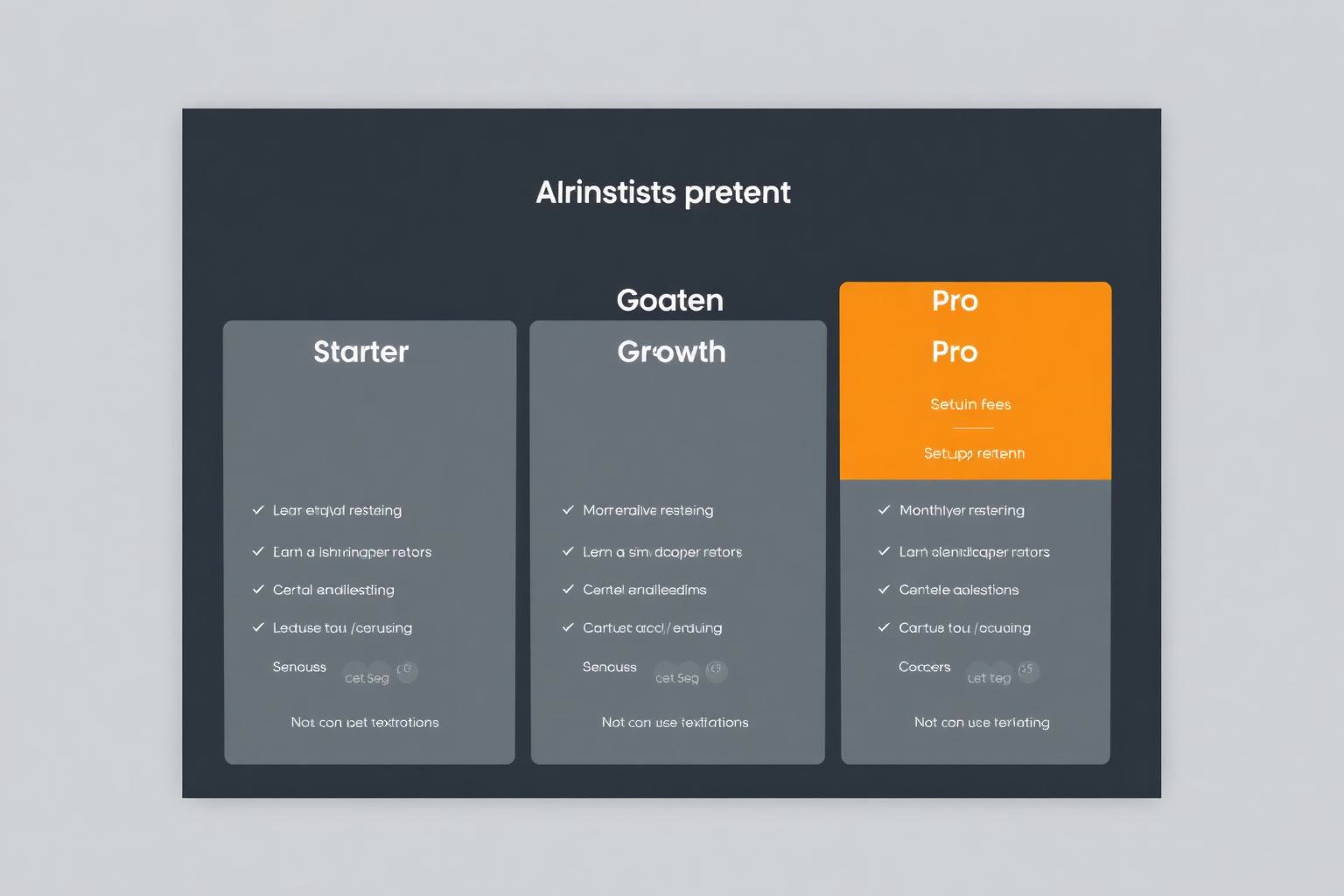
| Package | Setup Fee | Monthly Retainer | What Is Included | Best For |
|---|---|---|---|---|
| Starter | $500 | $300 | One phone number, basic booking, business hours only | Solo operators |
| Growth | $900 | $600 | One number, 24/7 booking, missed-call follow-up, SMS notifications | Salons, clinics, small agencies |
| Pro | $1,500 | $1,200 | Two numbers, lead qualification, CRM integration, custom voice, priority support | Multi-location or high-ad-spend businesses |
The Growth tier is my default recommendation. It has the strongest value proposition and the best margin. Most clients self-select into it after hearing the demo.
I always collect the setup fee before building. This filters out tire-kickers and covers my initial time. If a client hesitates at the setup fee, I offer to split it across the first two monthly invoices. That small concession has closed two deals for me.
Mistakes I Made and How to Avoid Them
I lost my first client because I skipped compliance. The agent did not disclose that it was automated, and a caller complained. The owner was upset, and I had to refund the setup fee. Now every agent starts with a clear disclosure: "Hi, you are speaking with [Business Name]'s automated assistant. I can book appointments and answer questions. Say 'human' at any time to speak with our team."
My second mistake was over-promising on accents and languages. A client asked for Spanish support, and I said yes before testing it. The agent misunderstood common names and dates. Now I only offer languages I have tested end-to-end, and I charge extra for multilingual setups.
The third mistake was building custom integrations too early. One client wanted a direct connection to their legacy CRM. The project took three weeks and paid the same monthly retainer as a simple Calendly integration. Today I have a standard integration list. Anything outside that list gets a custom quote.
Scaling to $5K and Beyond
Crossing $5,000 per month took four months. The revenue came from eight clients, mostly on the Growth tier. I did not run ads. All growth came from demos, referrals, and one local business Facebook group where I answered questions without pitching.
The next phase is productizing. I am building a reusable template that lets new clients go live in 48 hours instead of five days. I am also adding a simple client dashboard where owners can listen to call recordings, view booked appointments, and update their availability without asking me.
I am not hiring yet. The goal is to reach $10,000 per month with a lean stack before adding overhead. The beauty of this model is that one agent can serve multiple clients, and improvements to the core template benefit everyone.
Is AI Voice Agent Services Right for You?
This model fits you if you are comfortable talking to small business owners, building simple automations, and troubleshooting when a call goes wrong. It does not require advanced coding, but it does require patience. You will spend time listening to call recordings, fixing edge cases, and explaining the technology in plain language.
It is not a get-rich-quick scheme. The first month was slow. But once the demos started working and referrals kicked in, the flywheel turned. Local businesses talk to each other. One happy client can introduce you to three more.
If you are looking for a trending AI income stream with real demand, low startup cost, and monthly recurring revenue, AI voice agents deserve a serious look. Start with one niche, build one great demo, and offer five free demos to local businesses this week. The feedback will tell you exactly what to build next.
Key Takeaways
- AI voice agents solve real revenue leaks: missed calls, after-hours leads, and slow follow-up.
- The best first clients are service businesses that book appointments by phone and already spend money on ads.
- A working demo is more persuasive than any pitch deck; record a 60-second call with a real-sounding agent.
- Pricing should combine a setup fee with a monthly retainer so you are paid for both build and maintenance.
- Compliance, disclosure, and human handoff are non-negotiable for trust and long-term retention.
Frequently Asked Questions
What is an AI voice agent?
An AI voice agent is a software system that answers phone calls, understands spoken requests, and performs tasks such as booking appointments, qualifying leads, or taking messages. It uses large language models and text-to-speech to sound natural and respond in real time.
Do businesses need technical staff to use AI voice agents?
No. A well-built agent connects to the business's existing calendar, CRM, or booking system. The owner receives notifications by email or SMS, and the agent hands complex callers to a human when needed.
How much can I charge for an AI voice agent service?
Most providers charge a one-time setup fee of $500 to $1,500 and a monthly retainer of $300 to $800 per agent. Premium packages with multiple numbers, custom voices, and advanced integrations can reach $1,500 per month.
What tools do I need to build AI voice agents?
Popular stacks include Bland AI, Retell AI, or Vapi for the voice layer; Make, n8n, or Zapier for workflow automation; and Google Calendar, Calendly, or Airtable for booking. Total tool costs usually range from $50 to $200 per month per client.
Is this market already saturated?
Not for local, relationship-based sales. Most small service businesses still use voicemail or overworked receptionists. The opportunity is largest in mid-sized cities and specific niches such as dental clinics, HVAC companies, and med spas.
Frequently asked questions
What is an AI voice agent?
An AI voice agent is a software system that answers phone calls, understands spoken requests, and performs tasks such as booking appointments, qualifying leads, or taking messages. It uses large language models and text-to-speech to sound natural and respond in real time.
Do businesses need technical staff to use AI voice agents?
No. A well-built agent connects to the business's existing calendar, CRM, or booking system. The owner receives notifications by email or SMS, and the agent hands complex callers to a human when needed.
How much can I charge for an AI voice agent service?
Most providers charge a one-time setup fee of $500 to $1,500 and a monthly retainer of $300 to $800 per agent. Premium packages with multiple numbers, custom voices, and advanced integrations can reach $1,500 per month.
What tools do I need to build AI voice agents?
Popular stacks include Bland AI, Retell AI, or Vapi for the voice layer; Make, n8n, or Zapier for workflow automation; and Google Calendar, Calendly, or Airtable for booking. Total tool costs usually range from $50 to $200 per month per client.
Is this market already saturated?
Not for local, relationship-based sales. Most small service businesses still use voicemail or overworked receptionists. The opportunity is largest in mid-sized cities and specific niches such as dental clinics, HVAC companies, and med spas.
Keep reading

AI Evals as a Service: How I Charge $3,000 to Stop Client AI Features Breaking
Most teams ship an AI feature and then have no way to know when it breaks. Here is the eval suite I build in four weeks for $3,000, the retainer that follows it, and what nine engagements actually revealed.
August 8, 2026 · 2,335 words
Agentic Commerce: How I Charge $2,200 to Make Stores Buyable by AI Agents
AI shopping agents now research and check out on customers' behalf. Here is the audit I sell for $2,200, the four things that break on almost every store, and what the numbers actually looked like.
August 7, 2026 · 2,151 words

Computer-Use AI Agents: How I Charge $2,800 to Kill Back-Office Data Entry
Computer-use agents operate screens that have no API, which finally makes the ugliest back-office typing jobs sellable. Here is the exact offer, the five-day build, the numbers from four live clients, and the failures nobody puts in a case study.
August 6, 2026 · 2,414 words