AI UGC Ads: How I Sell 30 AI-Made Video Ads a Month for $1,800
I do not film anything, yet brands pay me $1,800 a month for 30 fresh short-form ads. Here is the exact pipeline, pricing, tool stack, and the $900 mistake that fixed my process.
The short answer
AI UGC ads are short vertical video ads where the presenter, voice and captions are AI-generated and a human assembles them into testable ad variants. Brands buy them for creative volume, not novelty: they need a new hook every week to keep paid social profitable. I sell batches of 8 to 30 ads for $450 to $1,800, with hard costs under $130 per batch, and the recurring retainer is where nearly all the profit sits.
Key takeaways
- Sell testable creative volume, not "AI videos" — the reframing doubled my reply rate.
- Price per batch and push toward monthly retainers; month two costs 30 percent less effort.
- Rendering one script across three or four AI presenters is the highest-leverage test.
- Label synthetic presenters and approve every claim in writing, or you lose the client.
- Real product footage plus burned-in captions is what keeps generated ads from looking generic.
Why AI UGC ads became the easiest thing I sell in 2026
Two years ago, if a supplement brand wanted thirty short-form video ads, they hired eight creators, shipped product samples, waited three weeks, and paid somewhere north of $4,000. I know because I coordinated exactly that kind of shoot for a client in 2024, and I remember the spreadsheet of chased invoices and missing footage.
Today I deliver the same volume in four days, alone, from a laptop in a rented room. Not because I got better at filming — I never film anything. I build AI UGC ads: user-generated-content-style vertical videos where the presenter, the voice, the b-roll and the captions are all generated, then assembled by a human who understands why an ad works.
This article is the full playbook from my own client work: how I price it, the exact production line, the tools I actually pay for, the legal and platform rules I follow, and the mistakes that cost me one client and about $900 in rework. My last invoice batch was $1,800 for 30 ads, and my hard costs were $128.
What "AI UGC" actually means to a buyer
Brands do not buy videos. They buy creative volume for testing. A performance marketer running Meta or TikTok ads burns through creative fast: a hook fatigues in 5 to 10 days, so the account needs a steady drip of new angles. That is the pain I sell into.
When I pitch, I never say "AI videos." I say: "You get 30 fresh testable ad variants per month, each with a distinct hook, ready to upload, in your brand voice." The AI part is my production method, not my value proposition. That single reframing doubled my reply rate on cold outreach.
The economics: what I charge and what it costs me
Here is my current rate card, which I landed on after six months of raising prices until people started hesitating.
| Package | Deliverable | Price | My hard cost | Time |
|---|---|---|---|---|
| Test batch | 8 ads, 2 hooks × 4 variants | $450 | ~$40 | 1 day |
| Growth batch | 20 ads, 5 hooks × 4 variants | $1,200 | ~$95 | 2–3 days |
| Retainer | 30 ads/month + reporting | $1,800/mo | ~$128 | 4 days |
| Rush | Any batch inside 48 hours | +40% | same | — |
Three things about this table matter more than the numbers.
First, I price per batch, not per video. Per-video pricing invites clients to nickel-and-dime and it caps me at the market rate for a freelance editor. Per batch, I am selling a testing system.
Second, the retainer is the whole business. One-off batches pay rent for a week. Four retainers pay rent for a year, and the second month of any retainer takes me 30 percent less time because the brand kit, avatar choice, caption style and approved claims are already locked.
Third, my margin is not the AI. My margin is that I know which 6 of the 30 ads will actually be worth scaling, and I tell the client which ones to put budget behind first. That advice is free. It is also why they renew.
A real month, itemized
For July I ran three retainers and one test batch: $5,850 collected. Tool spend was $214 (avatar/video generation credits, voice, stock b-roll, storage). Payment processing took $170. Net before tax: roughly $5,466 for about 14 working days. The remaining days went to outreach, which I will get to, because that is the part people skip.
My production line, step by step
The whole thing is a pipeline. Once it is a pipeline, quality stops depending on how inspired I feel.
Step 1 — Mine the hooks before touching a tool
I spend the first two hours reading, not generating. Sources, in order of value:
- The brand's own reviews — Amazon, Trustpilot, Shopify review widget. Real customer phrasing is the best hook library on earth.
- Support tickets and objections — I ask every client for their five most common pre-purchase questions.
- Competitor ad libraries — Meta Ad Library and TikTok Creative Center, filtered to ads running longer than 30 days. Longevity is a proxy for profitability.
- Reddit and niche forums — for the emotional framing, not the facts.
Out of that I write 5 hooks as plain text, first person, under 12 words each. "I stopped buying three different creams after this." "My dentist noticed in six weeks." If a hook does not survive being read aloud, it dies here.
Step 2 — Script to a fixed structure
Every 30-second script follows the same skeleton, and I do not deviate:
- 0–3s Hook. One spoken line, plus an on-screen text version that is different from the spoken line so viewers read and hear two angles.
- 3–8s Problem. Specific, sensory, no adjectives stacked.
- 8–18s Product as mechanism. How it works, not that it is amazing.
- 18–25s Proof. A number, a timeline, or a caveat. Caveats convert; I will explain why below.
- 25–30s Soft CTA. One action, one destination.
I generate first drafts with an LLM, then I rewrite every line by hand. Untouched AI copy has a rhythm — balanced clauses, tidy tricolons — that reads as advertising rather than as a person talking. The fastest fix is to break one sentence in every four so it is too short, and let one sentence run long and slightly messy, the way people actually speak.
Step 3 — Generate the presenter, then generate alternates
This is where the "9 thumbnails" grid comes in: for every locked script I render the same delivery across three to four different AI presenters. Different age, different energy, different room. It costs me minutes and it is the highest-leverage variable in the whole test — the identical script can triple its hold rate on a different face.
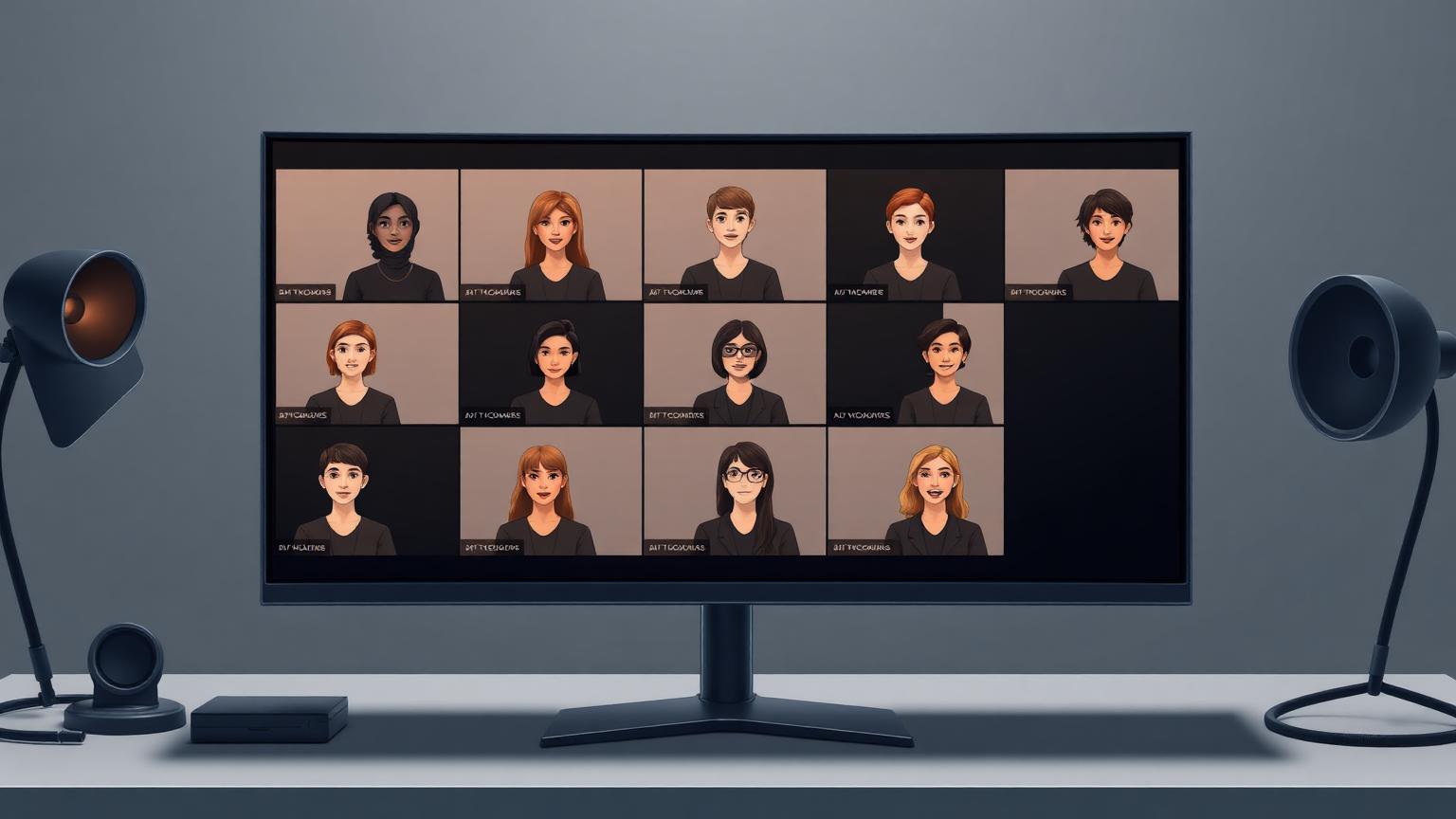
I keep a shortlist of presenters that have performed and reuse them across clients in unrelated categories. I do not reuse a presenter for two competing brands in the same niche; that is how a brand ends up looking synthetic to its own audience.
Step 4 — Assemble like an editor, not a generator
The generated talking-head clip is maybe 60 percent of the ad. The rest:
- Real product footage. I insist the client send me raw phone footage of the actual product — unboxing, texture, close-up, in-use. Thirty seconds of real product beats any generated substitute, and it keeps the ad honest.
- Captions burned in, styled once per brand, appearing word-by-word rather than line-by-line.
- Sound design. A room tone bed, one soft transition, and a music track at about -18dB. Silent-gap ads die on TikTok.
- A 0.5-second pattern break around the 7-second mark: a zoom, a cut, an on-screen circle. Retention graphs almost always sag there.
Step 5 — Deliver in a way that makes renewal obvious
I hand over a folder with files named for their variable: hook2_presenterB_captionA.mp4. Then a one-page note: which three to launch first, what each one is testing, and what result would make me double down. Clients forward that note to their boss. That note is my sales collateral.
The tool stack I actually pay for
Tools change every quarter, so treat this as a shape rather than a shopping list. What matters is having one option in each slot and not collecting six.
| Slot | What it does | Monthly cost band |
|---|---|---|
| AI presenter / video | Talking-head generation, multiple avatars | $30–90 |
| Voice | Cloned or licensed synthetic voice | $0–22 |
| Script assistant | Hook drafts, variant rewrites | $0–20 |
| Editor | Timeline, captions, batch export | $0–25 |
| Stock b-roll | Filler shots for pacing | $0–30 |
| Delivery + storage | Client folders, versioning | $0–12 |
Total realistic floor: about $60/month. I run around $180 because I pay for faster render queues, and speed is what lets me sell rush pricing at plus 40 percent.
One deliberate omission: I do not pay for an "all-in-one AI ad platform." I tried two. Both produced ads that looked like every other ad made on the same platform, which is precisely the thing a performance client cannot use.
Rules I follow so the work stays allowed and honest
This is the section most tutorials skip, and it is the section that determines whether you have a business in a year.
- Disclose synthetic presenters where the platform requires it. TikTok and Meta both have AI-content labels; I apply them. Labelled ads still perform. Unlabelled ads get reach-throttled or pulled, and the client blames you.
- Never generate a testimonial about a result that did not happen. An AI presenter delivering a brand's own approved claim is marketing. An AI presenter inventing "I lost 20 pounds" is a fabricated endorsement, and in regulated categories it is a legal problem for your client.
- Get written approval on the claims list. I keep a shared doc of allowed phrasings per client, signed off once. It has saved me from two rewrites.
- No lookalikes of real people. No celebrity faces, no voice clones of anyone who has not consented in writing. Get the voice licence, keep the receipt.
- Include the caveat. Ads that say "this will not fix everything, but it fixed this" consistently outperform pure hype in my accounts, and they are also true. Honesty happens to be a conversion tactic.
I lost a client in March because I shipped a batch where a generated presenter mentioned a specific timeline the brand had never verified. My mistake, caught in their legal review, and I refunded $900. Now every script passes a claims check before render. That refund bought me the process I use today.
Finding clients: the boring 70 percent
Production is the easy part. Here is what actually fills the calendar.
Cold outreach with a free sample. I pick 20 DTC brands per week that are visibly running paid ads, make one ad for each on spec — 30 seconds, their real product footage pulled from their site — and send it with two lines: "Made this from your product page, no strings. If it tests well I make 20 more." Reply rate around 18 percent. Close rate on replies, roughly a third.
Agency subcontracting. Media buyers are permanently short on creative. One agency relationship gave me two retainers without a single sales call. Agencies pay slower but buy consistently, and they never haggle over the AI part because they only care about cost per acquisition.
Public receipts. I post teardown threads: here is the hook, here is the retention curve, here is why the second version won. That content is why brands now message me first, and it took about four months of consistent posting before the first inbound.
Where I wasted time: freelance marketplaces at $50 per video, and "AI video" Facebook groups full of other people selling the same service to each other.
Reading the results so the client keeps paying
A batch that nobody measures is just files. Every Monday I open the client's ad account and look at four numbers per variant, in this order.
Three-second hold rate. This judges the hook and nothing else. Below roughly 30 percent on TikTok, the first line failed and the rest of the ad never mattered. I rewrite the hook and keep the body.
Fifteen-second retention. This judges the mechanism section. If viewers leave here, I explained the product instead of showing it, and the fix is usually more real product footage and fewer words.
Cost per click versus account average. A cheap click with no purchase means the hook promised something the landing page does not deliver. That is worth telling the client even though it is not my deliverable — it is the fastest way to become the person they consult rather than the person they buy from.
Cost per acquisition after 72 hours and $150 spend. Below that spend threshold I refuse to call anything a winner, and I say so out loud, because the single most expensive habit in performance creative is killing ads on day one based on noise.
Out of 30 ads, my honest expectation is 3 clear winners, about 8 that are usable with a new hook, and the rest dead. I tell clients that ratio before they pay. Setting the expectation at 10 percent winners makes three winners feel like a success instead of a disappointment, and it is the reason my renewal conversations are short.
What I would do differently starting from zero today
- Build the presenter shortlist before selling anything. Two days of testing which generated faces hold attention is worth more than two weeks of tool research.
- Charge from the first client. My first two batches were free "portfolio" work; both clients later refused to pay real rates because the anchor was set at zero.
- Specialise by category, not by tool. Once I focused on supplements and skincare, my hook library compounded and my batches got faster. The specialisation is the moat, not the software.
- Keep the human in the frame. The clients who renew are not buying generation. They are buying someone who reads their retention graph on a Monday and says "kill three, scale two, here is next week's angle."
Six to twelve months from now the tools in that stack will all have different names, and the presenters will be better. The part that will still be scarce is judgement about what makes a person stop scrolling — and a willingness to put your name on claims that are actually true.
Frequently asked questions
Do AI UGC ads actually convert as well as real creator ads?
In my accounts, AI-made ads win on volume and cost, not on peak performance. A great human creator ad still tends to produce the single best result, but I can ship 30 tested variants for less than the cost of one shoot, so the account finds a winner faster. The strongest setup is hybrid: AI presenter plus real product footage supplied by the brand.
How much do I need to spend to start?
About $60 a month covers one tool in each slot: video generation, voice, an editor, and storage. I started at that level and only upgraded to faster render queues once rush jobs were paying for it. There is no need for an all-in-one platform subscription.
Do I have to tell viewers the presenter is AI?
Yes, where the platform requires it. TikTok and Meta both provide AI-content labels and I apply them on every synthetic-presenter ad. Labelled ads still perform well, and unlabelled ones risk reduced reach or removal, which damages your client relationship far more than a small badge does.
What is the biggest legal risk in this service?
Fabricated testimonials. An AI presenter can deliver a brand's approved claim, but it must never invent a personal result. I keep a signed claims document per client and run every script against it before rendering. Regulated categories such as supplements and skincare are where this matters most.
How do I find the first paying client?
Make one ad on spec. Pick brands that are visibly running paid ads, build a 30-second ad from their existing product page footage, and send it with no strings attached. Roughly one in five replied for me, and about a third of those replies became paid batches.
Is this business going to survive as the tools improve?
The generation step will keep getting cheaper and easier, which means the production skill stops being the moat. What stays scarce is hook judgement, a category-specific library of what already worked, and someone who reads the retention data weekly and tells the client what to scale.
Keep reading

AI Evals as a Service: How I Charge $3,000 to Stop Client AI Features Breaking
Most teams ship an AI feature and then have no way to know when it breaks. Here is the eval suite I build in four weeks for $3,000, the retainer that follows it, and what nine engagements actually revealed.
August 8, 2026 · 2,335 words
Agentic Commerce: How I Charge $2,200 to Make Stores Buyable by AI Agents
AI shopping agents now research and check out on customers' behalf. Here is the audit I sell for $2,200, the four things that break on almost every store, and what the numbers actually looked like.
August 7, 2026 · 2,151 words
Computer-Use AI Agents: How I Charge $2,800 to Kill Back-Office Data Entry
Computer-use agents operate screens that have no API, which finally makes the ugliest back-office typing jobs sellable. Here is the exact offer, the five-day build, the numbers from four live clients, and the failures nobody puts in a case study.
August 6, 2026 · 2,414 words