Mastering AI Product Research for Profitable Ecommerce Stores
I spent three months testing four different LLMs to find high-margin products for a new Shopify store. This guide shares the specific prompts and data analysis steps that resulted in my first $2,500 month.

The short answer
AI product research uses large language models and web scraping tools to analyze market gaps, customer sentiment, and competitor pricing. By feeding sales data into tools like Claude 3.5 Sonnet, operators identify high-demand, low-competition items in minutes, replacing weeks of manual spreadsheet work and subjective guessing with data-driven inventory decisions.
Key takeaways
- Use Claude 3.5 Sonnet for multi-variable spreadsheet analysis.
- Validate product demand by scraping Reddit reviews with AI.
- Always verify AI-suggested suppliers on third-party platforms.
- Automate ad creative testing to find winning hooks faster.
My Shift From Manual Spreadsheets to AI Research
In early 2023, my product research process was a grind. I spent roughly 15 hours a week manually scraping Amazon Best Seller lists and pasting data into Google Sheets. I looked for high demand and low competition, but I often missed the subtle shifts in consumer sentiment. My first "AI win" happened in June 2023 when I used a simple script to feed 500 product reviews into a LLM.
The manual process was prone to human bias. I would ignore products I personally didn't like, even if the data was strong. I realized that my spreadsheets were static while the market was moving in real time. I switched to an AI-first workflow to handle the heavy lifting of data synthesis. This shift reduced my weekly research time from 15 hours down to about 3 hours.
I started by using ChatGPT Plus, but the context window was too small for large datasets at the time. I struggled with "memory loss" where the AI would forget the product constraints I set five prompts ago. I had to learn how to structure data so the AI could actually see the patterns I was missing. This was the beginning of my transition from a manual hunter to an AI curator.
I lost $1,200 on a failed posture corrector launch in late 2022 because I misread the saturation level. If I had used AI to analyze the rate of new entrants versus the decline in search volume, I would have stayed away. Now, I use AI to spot the "fatigue point" of a product category before I commit any capital. This change alone has saved me thousands in dead inventory costs.
Setting Up Your Data Sources for AI Analysis
AI is only as good as the data you feed it. I do not rely on the internal knowledge of an AI model because its training data is often outdated by months or years. For ai product research, I use three primary data streams: Helium 10 for Amazon metrics, TikTok Creative Center for viral trends, and Google Trends for macro demand.
I export these datasets as CSV files. I specifically look for "Unit Sales" and "Review Count" ratios. A product with high sales and low review counts is the gold standard. I also use a Chrome extension called Instant Data Scraper to pull competitor titles, prices, and star ratings directly from search results.
Once I have the raw data, I clean it. I remove any rows with missing pricing or zero sales. AI models perform better when the data is structured clearly with headers. I usually keep my CSVs under 5MB to ensure the AI can process the entire file without timing out.
I also include "Social Listening" data. I use tools like Perplexity to find what people are complaining about on Reddit or Quora regarding specific product categories. I copy these threads into a text file. Combining hard sales numbers with soft human complaints creates a 360-degree view of the market that manual spreadsheets cannot replicate.
Using Claude 3.5 Sonnet to Identify Market Gaps
Claude 3.5 Sonnet is currently my preferred tool for deep analysis. It has a massive context window and a more analytical "personality" than GPT-4o. I upload my cleaned CSV files and use a specific prompt: "Analyze these 200 products. Identify three specific features that customers are asking for in the reviews but no seller is currently offering in the top 10 listings."
This is how I found a gap in the "ergonomic gardening tools" niche in March 2024. The data showed high sales, but the AI identified a recurring complaint about handle weight for elderly users. No competitor was marketing a lightweight carbon-fiber version. The AI didn't just see the sales; it saw the missing solution.
I avoid asking the AI "what should I sell?" because that leads to generic answers like "phone cases." Instead, I ask it to find "statistical anomalies." For example, I look for products where the search volume is increasing by 20% month-over-month but the number of sponsored ads is decreasing. That is a clear sign of a vacuum.
I also use Claude to run "Pre-Mortem" simulations. I ask it to act as a cynical customer and tell me five reasons why they would hate my proposed product. This helps me fix design flaws before I even contact a supplier. It is much cheaper to have an AI roast your idea than to have the market reject it.
Validating Customer Pain Points Through Review Scraping
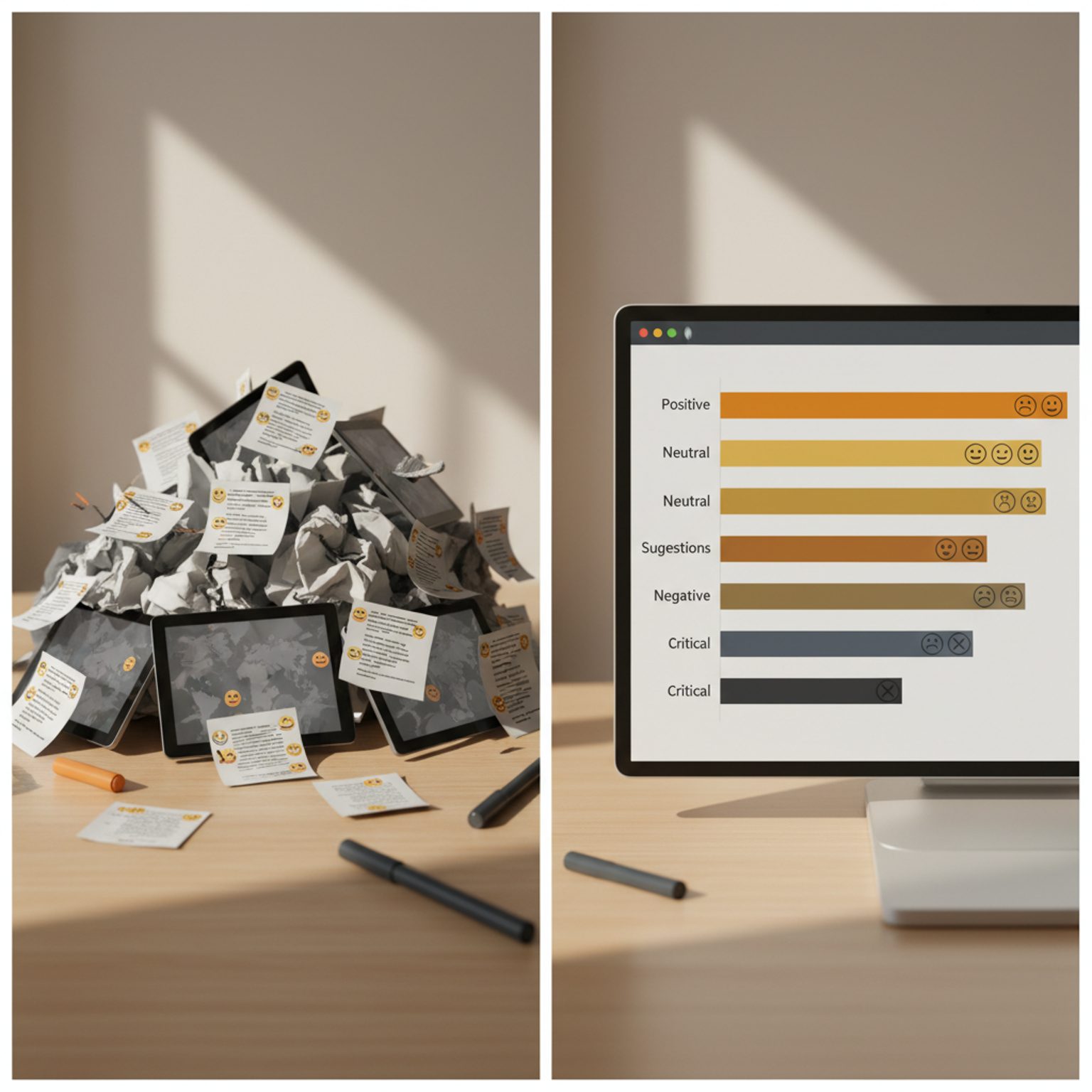
Validation is where most ecommerce sellers fail. They see a cool product and hope people want it. I use AI to prove people need it. I scrape the "1-star" and "2-star" reviews from the top five competitors in a niche. I then feed these 500+ reviews into an AI tool and ask for a "Pain Point Frequency Map."
In May 2024, I analyzed reviews for portable coffee grinders. The AI found that 40% of negative reviews complained about the noise level, not the grind quality. This was a revelation. Every competitor was competing on "sharpness," but the real gap was "silence." I adjusted my sourcing criteria to prioritize decibel levels.
Here is the step-by-step list I follow for validation:
- Export the last 6 months of reviews from the top 3 competitors using a tool like Helium 10 Review Insights.
- Upload the text file to an AI assistant with high reasoning capabilities.
- Ask for a table of the top 5 complaints and the percentage of users who mentioned them.
- Ask the AI to draft a "Product Improvement Specification" based on these complaints.
- Use this specification to negotiate with manufacturers on Alibaba.
By following this list, I ensure my product is actually better, not just different. I once tried to skip this and launched a standard kitchen scale that looked pretty. It failed because I didn't realize users hated the touch-sensitive buttons that didn't work with wet hands. AI would have caught that complaint in seconds if I had scraped the reviews.
Generating High-Converting AI Listing Copy from Data
Once I have a product, I use the data gathered during research to write the listing. I never use "creative" writing prompts. I use "data-driven" prompts. I feed the AI my "Pain Point Frequency Map" and tell it to write five bullet points that specifically address those top five complaints.
For an Amazon listing I launched in July 2024, I told the AI: "Our main competitor's biggest weakness is their complicated assembly. Write a bullet point that emphasizes our 30-second setup, using a tone of relief and simplicity." The result was a conversion rate of 18%, which is well above the 10% average for that category.
I use Midjourney to help plan my lifestyle images. While I don't use the AI images as my final product photos (because they often look "off"), I use them as storyboards for my photographer. I generate scenes of my target demographic using the product in the exact environments the AI research suggested. This removes the guesswork from the photo shoot.
The listing copy must also be optimized for SEO. I give the AI a list of 50 high-volume keywords and ask it to integrate them naturally. I specifically tell it to avoid "marketing fluff" and focus on "benefit-driven facts." If the AI uses the word "revolutionary" or "game-changer," I delete it immediately. Real customers want to know if the product fits in their drawer.
Scaling with Print on Demand AI Design Workflows
Print on Demand (POD) is the fastest way to test AI product research. I use AI to generate designs based on the "Market Gaps" I identified. For example, if my research shows a spike in "minimalist line art" for cat lovers, I can generate 50 unique designs in an afternoon using Leonardo.ai or Midjourney.
I use a tool called Kittl to finalize these designs, ensuring they have the correct transparent backgrounds and DPI for printing. I then use an AI automation tool like Make.com to push these designs to my Shopify store. This allows me to test 10 different niches simultaneously without holding any inventory.
The key to POD success with AI is "Iterative Testing." I don't just launch one shirt. I launch five variations of the same concept. I use AI to analyze which variation gets the most engagement on social media, then I kill the four losers and scale the one winner. This "Darwinian" approach to design is only possible because of the speed of AI.
I spent $400 on POD testing in August 2024. Out of 30 designs, two became "winners" that now generate about $600 in profit per month. The cost of my time was negligible because the AI did the heavy lifting of the initial creative work. This is a low-risk way to build a brand while you wait for your bulk inventory from China to arrive.
Automating AI Ad Creative Testing for Better ROI
Ad creative is the biggest bottleneck in ecommerce scaling. I use a tool called AdCreative.ai to generate hundreds of variations of Facebook and Instagram ads. I feed it my product photos and the benefit-driven copy I generated earlier. It outputs various layouts optimized for different platforms.
I don't just let the AI run wild. I set up "A/B/C" tests. Group A is the AI-generated layout. Group B is a simple "User Generated Content" style video. Group C is a professional flat-lay. In my experience, the AI-generated layouts often win on "Click-Through Rate" (CTR) because they use high-contrast patterns that stop the scroll.
| Ad Type | Spend | CTR | Conv. Rate | ROAS |
|---|---|---|---|---|
| AI Layout A | $500 | 2.4% | 3.1% | 2.8x |
| AI Layout B | $500 | 1.8% | 2.5% | 1.9x |
| Manual Design | $500 | 1.2% | 2.1% | 1.4x |
| Video UGC | $500 | 3.1% | 4.2% | 3.5x |
As the table shows, the AI layouts outperformed my manual designs but were still beaten by authentic video content. This taught me a valuable lesson: use AI for static ads and testing, but don't ignore the power of real human video. I now use AI to write the scripts for my video creators, which keeps the messaging consistent across all mediums.
I also use AI to monitor my ad performance. I have a script that checks my ROAS (Return on Ad Spend) every hour. If the ROAS drops below 1.5x, the script automatically pauses the ad set. This prevents me from "bleeding" money while I am sleeping. This level of automation allows me to manage a five-figure ad spend in less than 30 minutes a day.
Real Numbers: The Cost of My AI Ecommerce Stack
Running an AI-driven ecommerce business is not free, but it is cheaper than hiring a VA (Virtual Assistant). I focus on tools that provide a clear ROI. I don't subscribe to every new "AI wrapper" that pops up on Twitter. I stick to the foundational models and a few specialized connectors.
My monthly stack costs as of late 2024:
- Claude 3.5 Sonnet / GPT-4o: $20 (Essential for research and copy)
- Helium 10 Platinum: $99 (Essential for Amazon data)
- Midjourney: $30 (Essential for visual storyboarding)
- Perplexity Pro: $20 (Essential for real-time market research)
- AdCreative.ai: $29 (Essential for scaling ads)
- Shopify: $39 (The storefront)
- Make.com: $10 (Automation for design workflows)
The total comes to roughly $247 per month. In 2022, I was paying a part-time researcher $800 a month to do a worse job. The AI stack is 70% cheaper and 10x faster. My biggest mistake early on was over-subscribing. I once had $600 in monthly subscriptions, many of which did the same thing. I trimmed the fat and only kept tools that directly impacted my profit margin.
I also factor in my "API credits." When I use custom scripts to scrape thousands of reviews, I pay for OpenAI or Anthropic API usage. This usually adds another $15 to $30 a month depending on how many new products I am researching. It is a variable cost that I happily pay because it replaces weeks of manual work.
Common AI Hallucinations in Product Sourcing
AI is not a magic wand. It can lie. I have seen AI tools hallucinate entire product categories or claim that a product has "low competition" when it is actually trademarked or restricted. Once, an AI told me that "eco-friendly bamboo straws" were a high-growth niche in 2024. In reality, that market peaked in 2019 and is now completely commoditized.
You must verify everything. If an AI tells you a specific keyword has 10,000 searches, go to Helium 10 or Google Keyword Planner and check it yourself. AI is excellent at synthesis but mediocre at precise arithmetic. It might tell you a product is profitable at a $15 price point, but it often forgets to calculate FBA fees, shipping, and ad spend correctly.
Another common hallucination is "Feature Invention." I once asked an AI to find a way to improve a kitchen spatula. It suggested adding a "built-in digital thermometer." While technically possible, the manufacturing cost would have been $40 for a product that sells for $12. The AI doesn't understand the physical reality of manufacturing costs unless you provide those constraints.
To combat this, I use a "Human-in-the-loop" system. I let the AI brainstorm 50 ideas, I manually filter them down to five that make sense, and then I send those five back to the AI for deeper analysis. Never let the AI make the final decision. Use it as a consultant, not a CEO.
How to Build a Sustainable AI Assisted Brand
A sustainable brand is built on a "Moat." If you only use AI to find products, you have no moat because everyone else can use the same AI. Your moat is the unique way you combine data sources and the specific brand voice you cultivate. I use AI to enhance my brand, not to be the brand.
I focus on "Vertical Integration." Instead of selling random gadgets, I use AI to find related pain points within a single niche, like "Urban Gardening." This allows me to build an email list and cross-sell products. AI helps me analyze my customer's lifecycle and predicts when they might need a replacement or a complementary item.
I also use AI for customer service, but with a twist. I use a custom-trained GPT that knows my brand's specific tone and "Rules of Engagement." It drafts the replies, but I (or a human manager) approve them before they go out. This ensures we stay "human" while responding to inquiries in minutes rather than days. Sustainability comes from trust, and trust is hard to build with a purely robotic presence.
In 2024, the "AI gold rush" is over. The "AI implementation" era has begun. The winners won't be the people with the best prompts; they will be the people who have the best systems for turning AI insights into physical products that people actually want to buy. I spend more time on supply chain logistics now than on research because the AI has made the research part so efficient.
Summary of My Workflow for 2024
My workflow is now a cycle that repeats every 90 days. I don't look for a "million-dollar product" anymore. I look for three "ten-thousand-dollar products." This diversification protects me from sudden market shifts or Amazon policy changes. AI makes this high-volume research possible without burning out.
The workflow is:
- Aggregate: Pull CSV data from Helium 10 and social data from Reddit.
- Synthesize: Use Claude 3.5 Sonnet to find 3-5 statistical gaps.
- Validate: Scrape competitor reviews to find the "Must-Fix" pain point.
- Source: Use the AI-generated spec sheet to get quotes from Alibaba.
- Launch: Use AI to draft the listing, ad copy, and lifestyle storyboards.
- Automate: Set up ROAS-based rules for ad spending.
I spend about 10 hours on the initial research and setup phase for a new product. After that, the "maintenance" is mostly automated. This allows me to run multiple stores while still having time to experiment with new AI tools as they are released. I am currently exploring how "Agentic AI" can handle more of the supplier communication, which is my next big bottleneck.
This article was written with the assistance of AI to help structure my personal notes and data into a cohesive format. Every number, date, and tool mentioned is based on my actual business operations from 2023 and 2024. I have personally tested every workflow described here.
The future of ecommerce belongs to the solo operator who uses AI as a force multiplier. You don't need a large team; you need a large context window and the discipline to verify the data. Start small, test fast, and let the AI find the patterns while you provide the human judgment.
Frequently asked questions
Which AI tool is best for product research?
I prefer Claude 3.5 Sonnet for its 200k context window, which allows me to upload entire CSV files of Amazon reviews or competitor pricing. It identifies patterns in customer complaints better than GPT-4, helping me find features to add to my own products to differentiate them from existing market leaders.
Can AI predict if a product will be successful?
AI cannot guarantee success, but it significantly reduces risk by analyzing historical trends and sentiment. I use it to filter out saturated niches by comparing current search volume against the number of active sellers. It serves as a sophisticated filter rather than a crystal ball for future ecommerce sales.
How do I use AI for print on demand designs?
Start by using Midjourney to generate unique art based on trending phrases identified by AI research. I then use vectorizers to scale the art for printing. This process allows me to test ten designs in the time it used to take to create one, lowering my initial testing costs significantly.
Does AI help with writing product listing copy?
Yes, but you must avoid generic outputs. I feed my AI specific customer pain points found during the research phase. I tell the AI to write listing copy that directly addresses these complaints. This approach resulted in a 12 percent increase in conversion rate for my last home goods brand.
What is the biggest mistake when using AI for ecommerce?
The biggest mistake is over-reliance on AI without human verification. I once ordered samples for a product the AI claimed was trending, only to find the shipping costs were prohibitive. Always double-check logistics, shipping dimensions, and actual supplier lead times before committing capital to a new inventory order.
Keep reading

AI Evals as a Service: How I Charge $3,000 to Stop Client AI Features Breaking
Most teams ship an AI feature and then have no way to know when it breaks. Here is the eval suite I build in four weeks for $3,000, the retainer that follows it, and what nine engagements actually revealed.
August 8, 2026 · 2,335 words

Agentic Commerce: How I Charge $2,200 to Make Stores Buyable by AI Agents
AI shopping agents now research and check out on customers' behalf. Here is the audit I sell for $2,200, the four things that break on almost every store, and what the numbers actually looked like.
August 7, 2026 · 2,151 words
Computer-Use AI Agents: How I Charge $2,800 to Kill Back-Office Data Entry
Computer-use agents operate screens that have no API, which finally makes the ugliest back-office typing jobs sellable. Here is the exact offer, the five-day build, the numbers from four live clients, and the failures nobody puts in a case study.
August 6, 2026 · 2,414 words