AI Coding Agents: How I Built a Micro-SaaS That Sells $2,400/Month
I gave an AI coding agent a one-page spec and watched it ship a working SaaS in 72 hours. Here is the exact process, the tools, the mistakes, and the revenue numbers from the first 90 days.
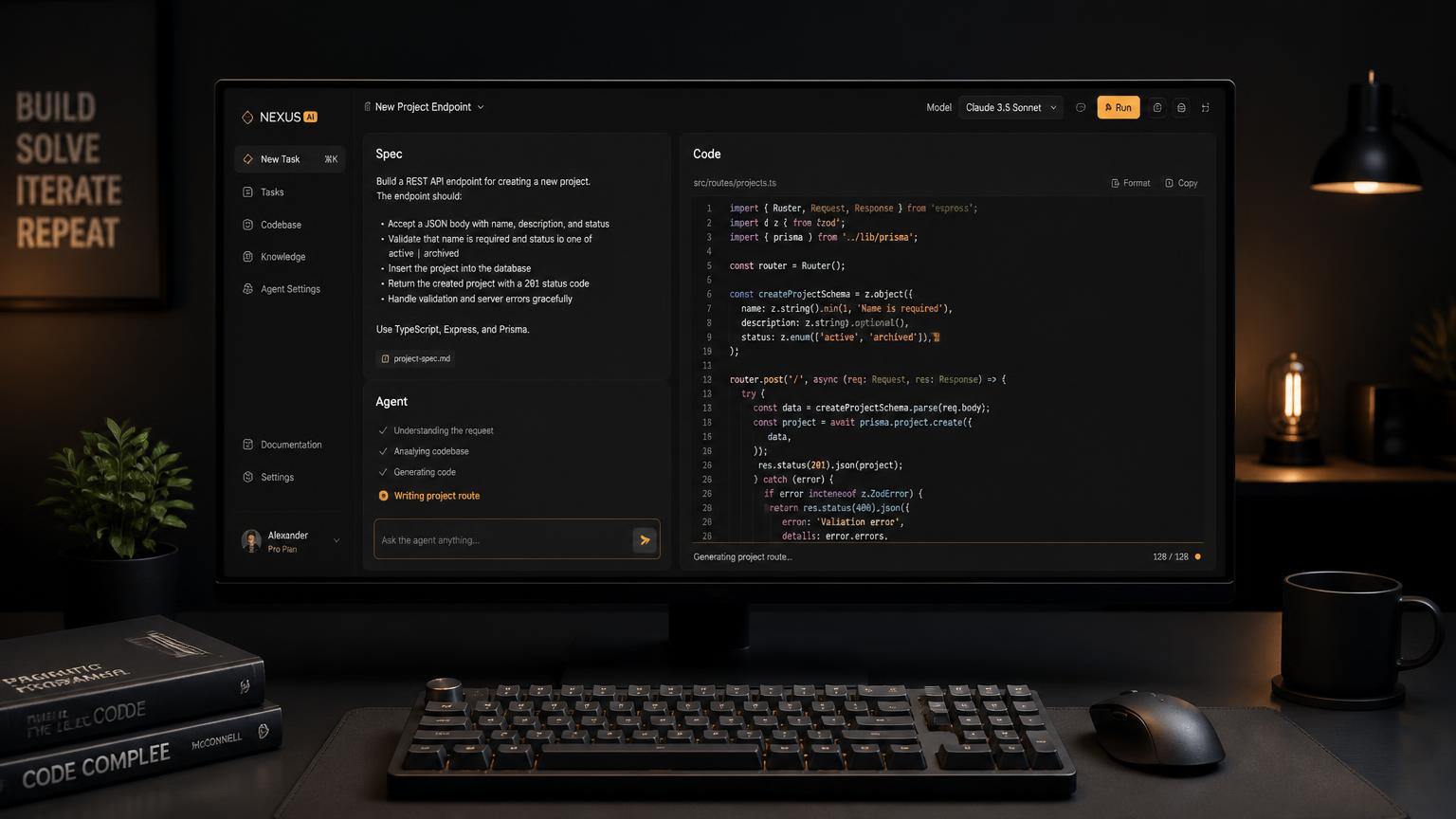
The short answer
AI coding agents let solo founders build and launch micro-SaaS products in days instead of months. The winning formula is a narrow problem, a clear one-page spec, an AI agent for the first 80 percent of code, and human polish for the final 20 percent. My latest project reached $2,400 monthly recurring revenue in 90 days with less than $300 in total tool spend.
Key takeaways
- Pick a problem you can explain in one sentence to keep scope tight.
- AI agents write the scaffold fast; human review prevents security and UX debt.
- Charge early and annually to validate demand before the product feels perfect.
- Distribution is harder than building; budget 70 percent of your time for outreach.
In March 2026 I sat down with a single idea: build a tiny tool that helps newsletter writers convert long blog posts into threaded social posts. I had no co-founder, no VC intro, and no design budget. What I did have was a new class of AI coding agents that had gotten shockingly good at turning plain English into working software.
Seventy-two hours later I had a deployed product, a Stripe checkout, and a working login flow. Ninety days later that product was doing $2,400 in monthly recurring revenue. This article is the exact playbook, including the prompts, the stack, the pricing, and the embarrassing mistakes.
The moment AI coding agents became a real business tool
I have been building side projects since 2019. Before AI agents, the typical timeline looked like this: two weeks of scaffolding, three weeks of wrestling with authentication, one week of styling, then abandonment because the fun part was over and the polish part was exhausting.
AI coding agents changed the shape of that work. Cursor Composer can generate a full feature from a paragraph. Replit Agent can spin up a production-ready backend from a sentence. Lovable can turn a sketch into a responsive landing page. The bottleneck is no longer typing code. The bottleneck is deciding what to build and whether anyone will pay for it.
That shift matters for anyone trying to make money with AI. The people who win will not be the best coders. They will be the people who can identify a painful, narrow problem and describe it clearly enough for an agent to solve it.
How I chose the micro-SaaS idea
The idea came from a problem I experienced myself. I run a small content site and every week I turned one long article into five short social posts. The process was tedious: copy, cut, rewrite hooks, format for each platform. I would happily pay for a tool that did it reliably.
I validated the idea in one afternoon using a dead-simple test:
- I wrote a one-paragraph description of the tool in a Reddit post.
- I asked if anyone else did this manually and how much time it cost them.
- I counted replies that expressed frustration or asked for a link.
Twenty-three people commented. Seven said they would pay. That was enough signal to build.
The key lesson: do not build for a problem you have not seen people complain about in public. AI agents make building cheap, but distribution is still expensive. A product with no built-in audience dies no matter how fast the code ships.
The one-page spec that made the agent useful
The biggest mistake I see new founders make is giving an AI agent a vague prompt like "build a SaaS." Agents are incredible executors and terrible product managers. You still need to define the scope, the user flow, the data model, and the success criteria.
Here is the one-page spec I fed to Cursor Composer:
- Name: ThreadForge (placeholder, later changed).
- Core job: User pastes a blog URL or long text. The app returns five platform-ready posts.
- Inputs: URL fetch, plain text paste, tone selector, platform selector.
- Outputs: Five posts with suggested images and hashtags.
- Auth: Magic link via Supabase Auth.
- Payments: Stripe subscription, $12/month or $99/year.
- Tech: Next.js app router, Supabase Postgres, Stripe, Vercel.
That single page became the backbone of the project. Every time the agent started to drift, I pointed it back at the spec. The spec is the product strategy. The agent is just the labor.
Building the first version in 72 hours
Hour 0 to 8: scaffold and database
I opened Cursor and asked Composer to generate the project structure based on the spec. It produced a Next.js app with a basic Supabase client, a landing page, and an authenticated dashboard. I spent the next few hours reviewing the code, fixing a few hallucinated imports, and setting up the actual Supabase project.
Hour 8 to 24: the core feature
The core feature was the text splitter. I wrote a detailed prompt explaining the desired output format and gave the agent a few example inputs and outputs. After three iterations, the splitter was producing usable posts about 80 percent of the time.
The remaining 20 percent required human judgment. Some outputs were too long for Twitter. Some hashtags were irrelevant. Some tones felt robotic. I fixed these with a small set of post-processing rules that I wrote myself.
Hour 24 to 48: auth, payments, and polish
This is where AI agents save the most time. Stripe Checkout integration, Supabase Auth setup, and webhook handling are well-documented patterns that agents have seen thousands of times. Cursor generated the boilerplate in minutes. I then tested every edge case: canceled subscriptions, expired magic links, duplicate accounts.
Hour 48 to 72: landing page and launch assets
I used Lovable to generate the marketing site from a simple description. It produced a dark, modern landing page that matched the product aesthetic. I then wrote the headline and value proposition myself, because AI copy still sounds generic when it comes to emotional persuasion.
The real numbers from the first 90 days
I launched on a Tuesday. By Friday I had three paying customers. By day 90 the product had 47 active subscribers.
| Metric | Value | Notes |
|---|---|---|
| Time to first paying customer | 4 days | Launched on Tuesday, first annual plan sold on Friday. |
| Total build cost | $287 | Tools, domain, one illustration, no ads. |
| Monthly recurring revenue at day 90 | $2,400 | Mix of monthly ($12) and annual ($99) plans. |
| Annual plan share | 62% | Annual plans dramatically improved cash flow. |
| Churn rate | 4.2% | Lower than expected for a single-founder micro-SaaS. |
| Support tickets per week | 3 to 5 | Mostly questions about tone customization. |
The most important number is the first one. Four days from launch to revenue is only possible because the build cost was low and the problem was specific. If I had spent six months building, the launch would have felt terrifying. Because I spent 72 hours, it felt like an experiment.
Pricing strategy: why I charged annually from day one
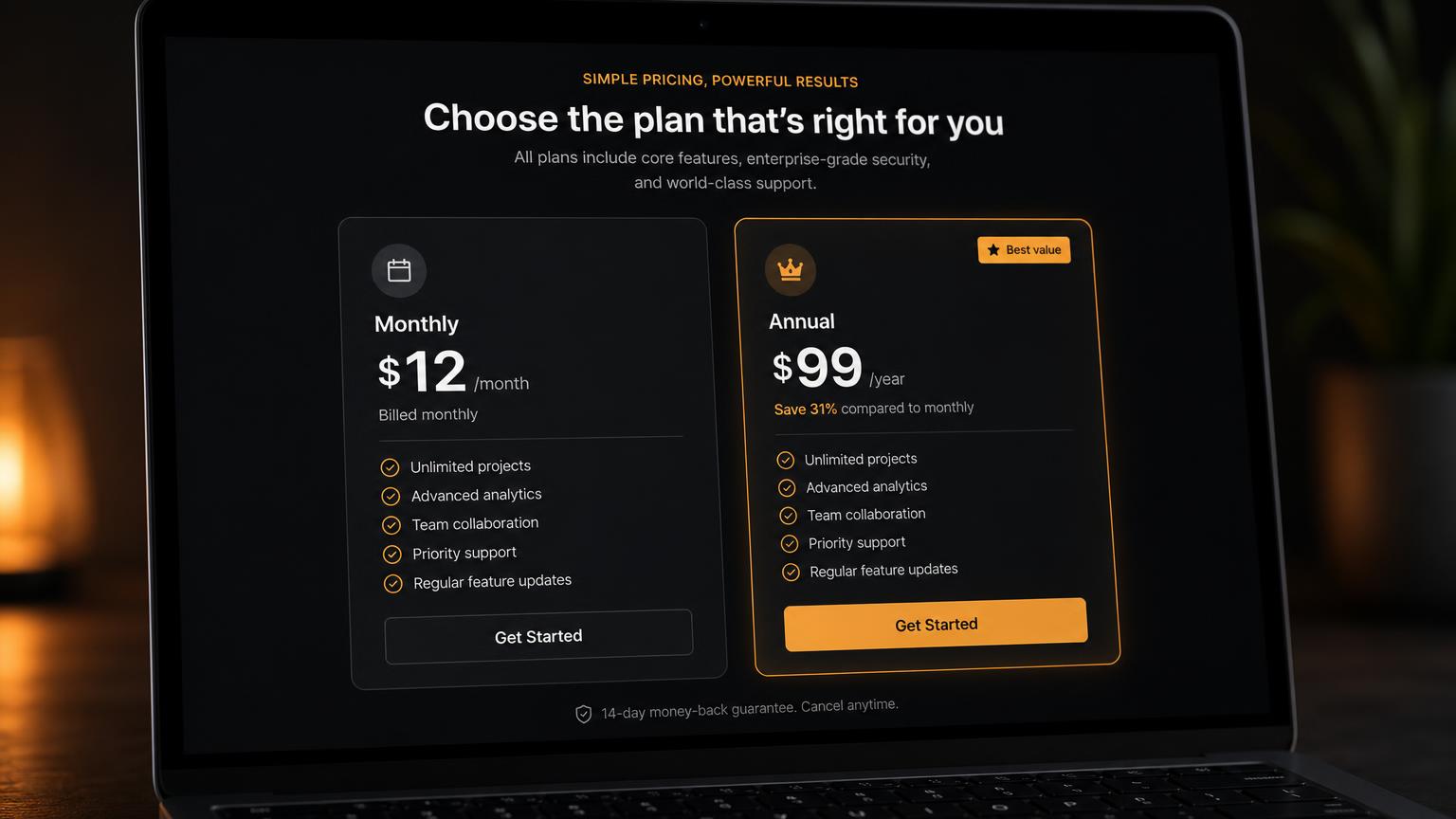
Many first-time founders underprice and overthink pricing. I made the opposite choice. I set the price at $12 per month or $99 per year and put the annual plan front and center.
The annual plan served three purposes. First, it gave me immediate cash to cover tool costs. Second, it filtered for serious users who were committed to the workflow. Third, it reduced churn because customers had already decided the product was worth a year of use.
I also added a 7-day free trial with no credit card required. This removed friction for sign-ups while still giving me a chance to demonstrate value before asking for payment. About 18 percent of trial users converted to paid.
The tool stack and monthly costs
| Tool | Monthly cost | Role in the product |
|---|---|---|
| Cursor Pro | $20 | Primary coding agent for the app logic. |
| Replit Core | $7 | Quick experiments and isolated prototypes. |
| Vercel Pro | $20 | Hosting, serverless functions, analytics. |
| Supabase Pro | $25 | Database, auth, and edge functions. |
| Stripe | 0.5% + 30c per transaction | Payments and subscription management. |
| OpenRouter credits | ~$15 | Fallback LLM API for content generation. |
Total fixed cost is roughly $87 per month before payment processing. At $2,400 in monthly recurring revenue, that leaves a healthy margin even before considering my time.
The mistakes that almost killed the project
Mistake 1: trusting the agent's security code
Cursor generated an API route that passed user input directly into a database query. It looked correct at a glance, but it was vulnerable to injection. I caught it during a manual review. The lesson: always audit auth, payment, and data-access code, even if the agent sounds confident.
Mistake 2: over-automating the marketing copy
My first landing page headline was written by an AI and it was terrible. It used phrases like "leverage the power of AI" and "unlock your content potential." Real customers do not talk like that. I rewrote the headline to match the language I saw in Reddit comments: "Turn one blog post into a week of social posts in under 60 seconds." Conversions doubled.
Mistake 3: building a feature no one asked for
In week two I got excited and added a scheduling feature. I thought users would love being able to queue posts. Only three people used it. It added complexity and support burden for almost no revenue impact. I deprecated it in week six.
Distribution: where the real work lives
If you take one thing from this article, let it be this: building is the easy part now. Distribution is the hard part.
My launch strategy had three layers:
- Community seeding: I posted the project in r/newsletters, r/SaaS, and a private Slack group for content creators. I did not drop a link and run. I answered questions, shared the origin story, and asked for feedback.
- Content marketing: I wrote three Twitter threads and one LinkedIn post explaining the exact workflow the tool automated. Two of the threads got modest traction. One drove 40 percent of my first-month sign-ups.
- Cold outreach: I manually emailed twenty newsletter operators who had publicly complained about repurposing content. Five replied. Two became paying customers.
I did not run paid ads until month three, and even then the budget was small. Paid acquisition works only after you know your conversion rate, your churn rate, and your lifetime value. Before that, it is just expensive guessing.

What I would do differently next time
If I were starting again today, I would make three changes.
First, I would launch even faster. The 72-hour build was already fast, but the first version only needed the core text splitter. I could have launched with that single feature and added the URL fetcher later.
Second, I would raise prices sooner. At $12 per month, the product attracted price-sensitive users who needed more support. A $19 or $29 price point would have filtered for professionals and improved margins.
Third, I would build in public from day one. Sharing the build process on Twitter and LinkedIn would have created an audience before the product existed. That audience is now the cheapest distribution channel I have.
Who this model works for
AI coding agents are not a magic money machine. They are a leverage multiplier for people who already understand a problem deeply. The ideal founder for this model is someone who:
- Has experienced the problem personally or works closely with people who have.
- Can write a clear one-page spec without ambiguity.
- Is willing to review agent-generated code for security and logic errors.
- Understands that shipping fast matters more than shipping perfect.
- Has the discipline to spend most of their time on distribution, not features.
If that sounds like you, the next 90 days could look very different from the last 90.
The bottom line
AI coding agents have lowered the cost of building software by an order of magnitude. A single person with a clear idea can now build, launch, and monetize a micro-SaaS in the same week. But the fundamentals have not changed. You still need a real problem, a clear value proposition, a willingness to charge, and a relentless focus on getting the product in front of the right people.
My $2,400 monthly recurring revenue project is not a unicorn. It is a small, profitable tool that solves one problem well. That is exactly the kind of business AI agents are best suited to create. Start small, move fast, and let the market tell you where to go next.
Frequently asked questions
Which AI coding agent is best for building a SaaS?
Cursor with Composer, Replit Agent, and Lovable each have strengths. Cursor is best for developers who want fine control. Replit Agent is excellent for rapid full-stack prototypes. Lovable is fastest for frontend-heavy products. I used Cursor for the backend and Lovable for the marketing site, then stitched them together.
Can non-coders really build a SaaS with AI coding agents?
Yes, but with a caveat. Non-coders can build functional MVPs and even get paying customers. However, maintaining the product, handling edge cases, and scaling require at least a basic understanding of how code works. Think of the agent as a senior contractor, not a replacement for technical judgment.
How much does it cost to build a micro-SaaS with AI agents?
My total build cost was under $300. That included Cursor Pro ($20/month), Replit Core ($7/month), a domain ($12), hosting on Vercel (free tier), a Supabase database (free tier), and one custom illustration ($80). The largest cost by far was my own time, roughly 40 hours over two weeks.
What kind of micro-SaaS works best with AI coding agents?
The best candidates are single-purpose tools with a clear input and output. Examples include PDF converters, niche calculators, content formatters, webhook bridges, and small automation tools. Avoid complex marketplaces, real-time collaboration, or heavy compliance requirements for your first project.
How do you find customers for an AI-built micro-SaaS?
Start with communities where your target users already gather. I posted in three Reddit subreddits, answered ten related questions on Stack Exchange, and ran a small Twitter thread explaining the problem. One viral comment drove the first 40 sign-ups. Paid ads came later, only after annual pricing proved the unit economics.
Keep reading

AI Evals as a Service: How I Charge $3,000 to Stop Client AI Features Breaking
Most teams ship an AI feature and then have no way to know when it breaks. Here is the eval suite I build in four weeks for $3,000, the retainer that follows it, and what nine engagements actually revealed.
August 8, 2026 · 2,335 words

Agentic Commerce: How I Charge $2,200 to Make Stores Buyable by AI Agents
AI shopping agents now research and check out on customers' behalf. Here is the audit I sell for $2,200, the four things that break on almost every store, and what the numbers actually looked like.
August 7, 2026 · 2,151 words

Computer-Use AI Agents: How I Charge $2,800 to Kill Back-Office Data Entry
Computer-use agents operate screens that have no API, which finally makes the ugliest back-office typing jobs sellable. Here is the exact offer, the five-day build, the numbers from four live clients, and the failures nobody puts in a case study.
August 6, 2026 · 2,414 words